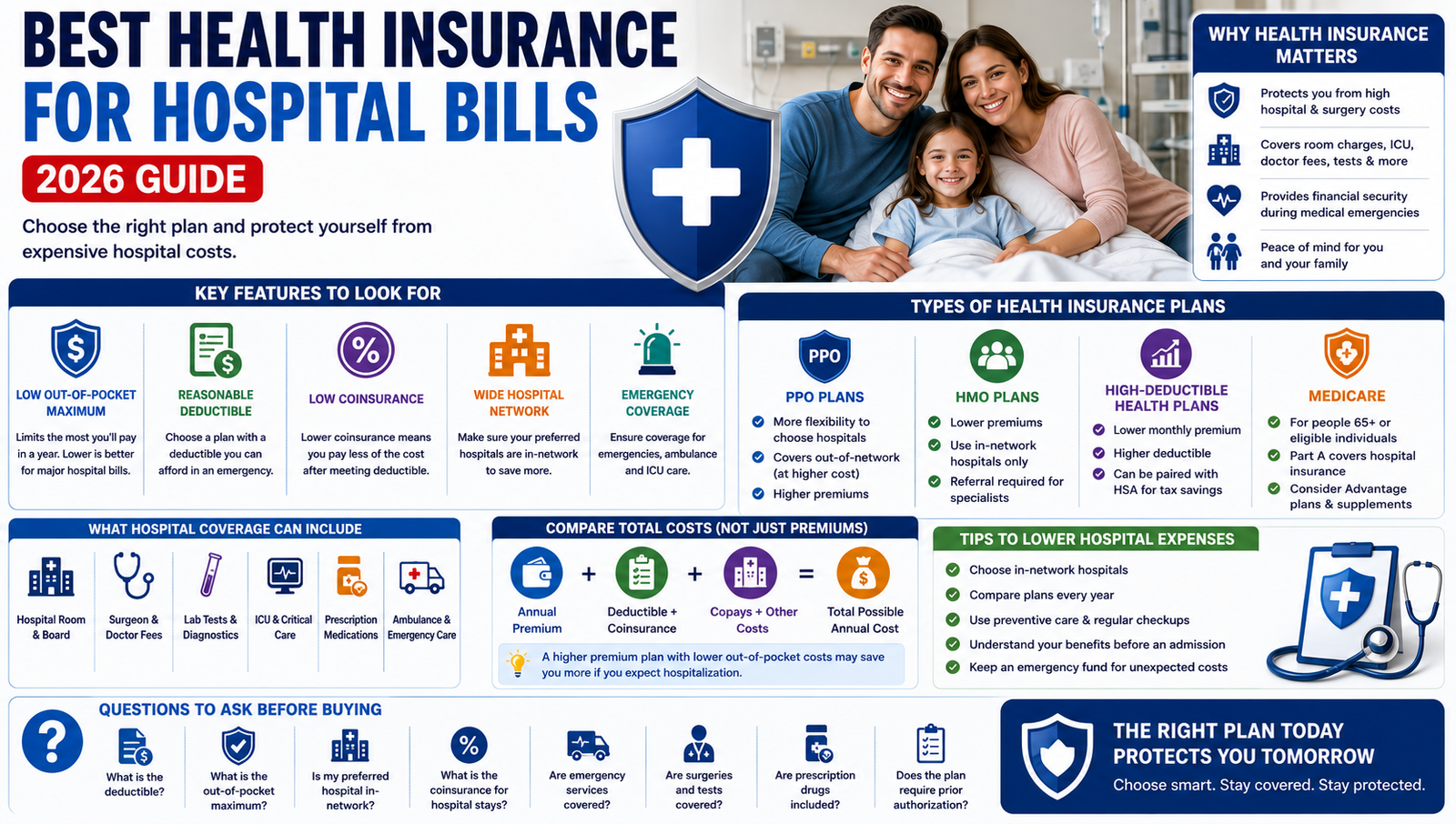
Hospital bills in the United States can become extremely expensive when someone needs emergency treatment, surgery, intensive care, or a prolonged hospital stay. Even people who have health insurance may still have to pay deductibles, copayments, coinsurance, and other eligible out-of-pocket expenses.
Choosing the best health insurance for hospital bills is therefore an important financial decision. The right plan should provide strong hospitalization coverage while keeping your monthly premium and potential out-of-pocket costs manageable.
This 2026 guide explains what to look for when choosing health insurance for hospital expenses, how different plans work, and which features can provide better financial protection.
Why Hospital Insurance Coverage Matters
Hospitalization can happen unexpectedly. An accident, serious infection, major illness, surgery, or other medical emergency may require expensive treatment.
Hospital charges can include:
- Emergency room services
- Hospital room and board
- Physician fees
- Surgery
- Diagnostic tests
- Laboratory services
- Imaging
- Prescription medications
- Intensive care
- Ambulance services
- Rehabilitation and follow-up care
Without adequate insurance, these expenses can place a significant burden on an individual or family.
Health insurance helps reduce these costs by covering eligible medical services according to the terms of the policy. However, different plans can have very different deductibles, networks, and cost-sharing requirements.
What Is the Best Health Insurance for Hospital Bills?
There is no single health insurance plan that is best for everyone. The ideal plan depends on your health needs, location, budget, preferred doctors, and expected healthcare expenses.
When hospitalization coverage is your priority, focus on several important features.
1. Low Out-of-Pocket Maximum
The out-of-pocket maximum is one of the most important factors to consider.
It generally represents the maximum amount you pay during a plan year for covered services, subject to the plan’s rules. Once you reach the applicable limit, the insurance company generally pays 100% of covered in-network benefits for the remainder of the plan year.
A plan with a lower out-of-pocket maximum may offer stronger financial protection against a major hospitalization.
However, plans with lower out-of-pocket limits can have higher monthly premiums, so compare the total potential cost.
2. Reasonable Deductible
The deductible is another important consideration.
A high-deductible health plan may have a lower monthly premium, but you could have to pay a substantial amount toward covered healthcare expenses before the plan begins paying according to its cost-sharing structure.
If you are concerned about hospital expenses, consider whether you could comfortably afford the deductible in an emergency.
A plan with a somewhat higher monthly premium but a lower deductible may be more suitable for someone who expects regular healthcare use.
PPO Plans for Hospital Coverage
A Preferred Provider Organization (PPO) plan can be attractive for people who want flexibility when choosing healthcare providers.
PPO plans generally provide access to a network of doctors and hospitals at negotiated rates. Many PPO plans also provide some coverage for eligible out-of-network care, although the cost can be considerably higher.
For hospitalization, it is particularly important to check whether your preferred hospital participates in the plan’s network.
PPO plans may have higher premiums than some other plan types, but the additional flexibility can be valuable for people who travel frequently or want broader provider access.
HMO Plans for Hospital Coverage
A Health Maintenance Organization (HMO) plan generally focuses on receiving care through a specific network of healthcare providers.
HMO plans can sometimes have lower premiums and predictable cost-sharing compared with other plan types. However, out-of-network coverage may be limited except for certain circumstances, such as emergencies.
If you choose an HMO, check whether nearby hospitals and your preferred doctors are included in the network.
For people who are comfortable using a defined network, an HMO may offer a cost-effective way to obtain hospital and medical coverage.
High-Deductible Health Plans
High-deductible health plans, or HDHPs, generally combine lower monthly premiums with higher deductibles.
These plans may work well for relatively healthy individuals who do not expect frequent medical care and want protection against major healthcare expenses.
However, you need to consider your ability to pay the deductible if hospitalization occurs.
Some HDHPs may also be paired with a Health Savings Account (HSA), which can provide a tax-advantaged way to save money for eligible healthcare expenses if you meet the applicable requirements.
Medicare and Hospital Coverage
For eligible older adults and certain other individuals, Medicare can play an important role in paying hospital expenses.
Original Medicare includes Part A hospital insurance, while Part B generally covers medically necessary physician and outpatient services.
Medicare beneficiaries may also consider Medicare Advantage and supplemental coverage depending on their circumstances.
Because Medicare options have different premiums, networks, deductibles, and cost-sharing rules, it is important to understand how each option handles hospitalization before enrolling.
Marketplace Health Insurance
Individuals and families who do not have suitable employer-sponsored coverage may be able to purchase health insurance through the Health Insurance Marketplace.
Marketplace plans generally cover essential health benefits, including hospitalization.
Plans are commonly divided into Bronze, Silver, Gold, and Platinum categories. These categories generally reflect how healthcare costs are divided between the insurance company and the member.
A Bronze plan may have a lower premium but higher costs when you use healthcare services. Gold or Platinum coverage may have higher premiums but lower cost-sharing.
If hospital coverage is your main concern, compare the deductible, coinsurance, and out-of-pocket maximum rather than focusing only on the monthly premium.
Hospital Network Is Extremely Important
One of the biggest mistakes consumers can make is choosing a health insurance plan without checking the hospital network.
A plan may look affordable, but if your preferred hospital is out of network, you could potentially face substantially higher expenses.
Before enrolling, verify that:
- Your preferred hospital is in network
- Emergency services are covered according to the plan’s rules
- Your primary doctor participates in the network
- Your specialists are included
- Nearby urgent-care facilities are covered
- The hospital has access to the specialists you may need
Network information can change, so verify it directly with the insurer before receiving planned care.
Compare Total Annual Costs
When comparing health insurance for hospital bills, don’t look only at monthly premiums.
For example, consider a hypothetical plan with a low premium but a high deductible and high coinsurance. Another plan might have a higher premium but a lower deductible and lower out-of-pocket maximum.
If you rarely use healthcare, the first plan could cost less overall. If you expect surgery or hospitalization, the second plan might provide greater financial protection.
A useful comparison includes:
Annual premiums + expected out-of-pocket healthcare costs = potential total annual cost.
Also consider the maximum amount you could potentially have to pay for covered services.
Additional Hospital Protection
Some people may consider supplemental products such as hospital indemnity insurance alongside their primary health insurance.
Hospital indemnity insurance can provide a fixed cash benefit for certain covered hospitalizations or medical events. Depending on the policy, the benefit may help with expenses associated with hospitalization.
However, hospital indemnity insurance should generally be viewed as supplemental coverage rather than a replacement for comprehensive medical insurance.
Questions to Ask Before Choosing a Plan
Before purchasing health insurance, ask:
- What is the monthly premium?
- What is the annual deductible?
- What is the out-of-pocket maximum?
- Is my preferred hospital in network?
- What percentage of hospitalization costs does the plan cover?
- How much is hospital coinsurance?
- Are emergency services covered?
- Are surgery and specialist fees covered?
- Are prescription medications covered?
- Does the plan require prior authorization?
- Are there separate deductibles for specific services?
- What happens if I need out-of-network emergency care?
Review the plan’s Summary of Benefits and Coverage and full policy documents before making a final decision.
Final Thoughts
The best health insurance for hospital bills in 2026 is not necessarily the plan with the cheapest monthly premium. Strong hospitalization protection requires looking at the deductible, coinsurance, out-of-pocket maximum, hospital network, emergency coverage, and overall plan benefits.
PPO, HMO, HDHP, Marketplace, employer-sponsored, and Medicare options can all provide valuable hospital coverage depending on your circumstances.
If hospitalization is your primary concern, prioritize a plan that offers access to quality hospitals and provides manageable financial exposure in the event of a major medical emergency. Compare several plans carefully, verify network participation, and consider both your expected healthcare needs and your ability to handle unexpected expenses.
Ultimately, the right health insurance plan should give you reliable access to hospital care and meaningful financial protection when you need it most.