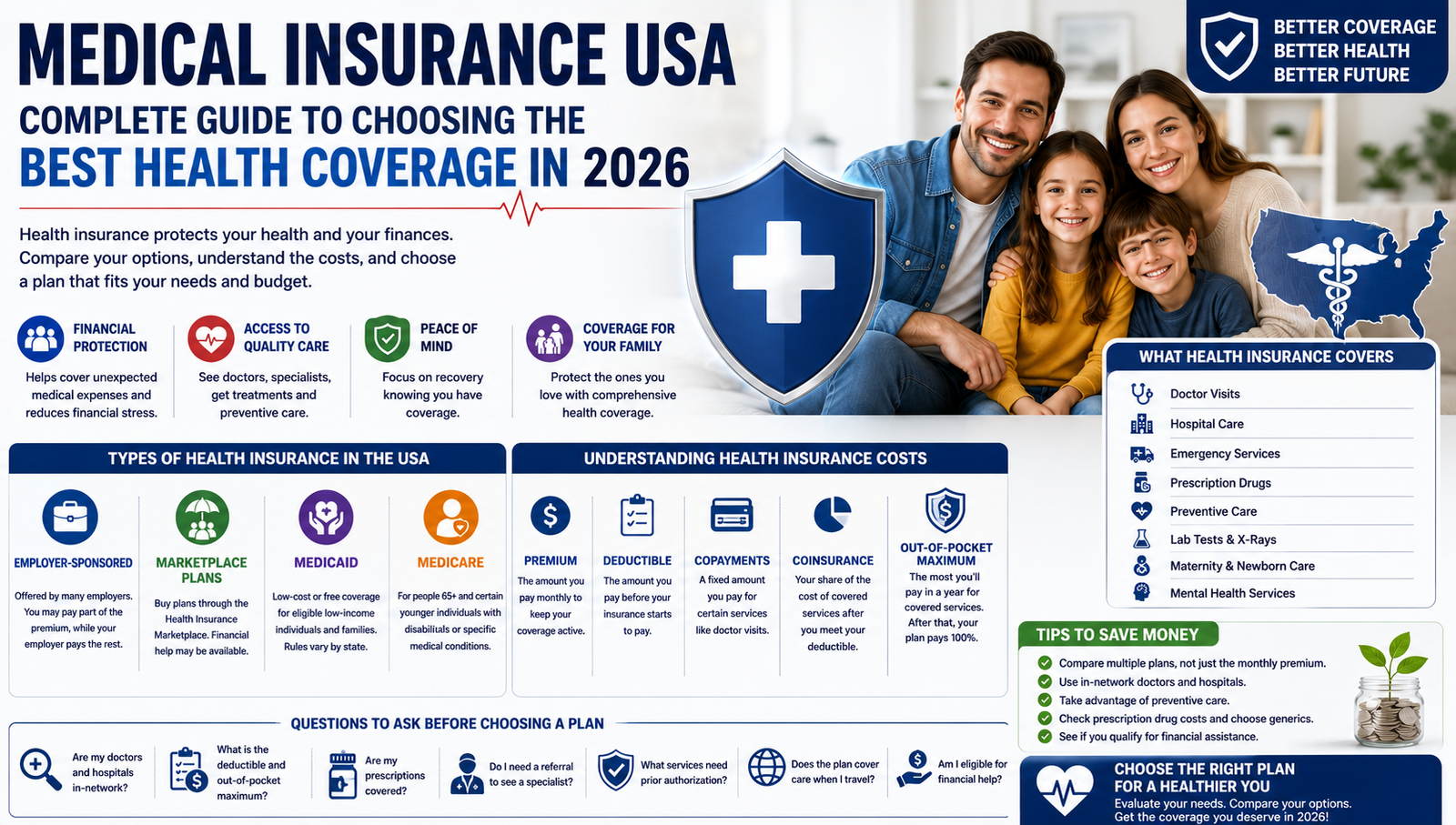
Medical insurance is an important part of financial planning in the United States. Healthcare costs can be expensive, and an unexpected illness, accident, hospitalization, or medical procedure can create significant financial pressure. Having the right health insurance can help protect you from large medical bills while giving you access to doctors, hospitals, specialists, prescription medicines, and preventive care.
In 2026, Americans have several health insurance options, including employer-sponsored plans, Marketplace coverage, Medicaid, Medicare, and other private insurance policies. Because plans can differ significantly in price, benefits, networks, and cost-sharing, it is important to compare your options carefully.
This guide explains how medical insurance works in the USA and what to consider when choosing the right coverage in 2026.
What Is Medical Insurance?
Medical insurance, commonly called health insurance, is a contract between you and an insurance company that helps pay for eligible healthcare expenses.
In exchange for coverage, you generally pay a monthly premium. When you receive covered healthcare services, you may also be responsible for costs such as deductibles, copayments, and coinsurance.
Health insurance can help cover a wide range of services, including doctor visits, preventive care, emergency treatment, hospitalization, laboratory tests, prescription drugs, and specialist services. The exact benefits depend on the specific plan.
The primary purpose of medical insurance is to reduce the financial impact of healthcare expenses while providing access to necessary medical services.
Why Is Health Insurance Important in the USA?
Healthcare services in the United States can be costly, particularly when someone needs emergency treatment or long-term care.
Without insurance, a hospital stay, surgery, specialist treatment, or ongoing prescription medication can result in substantial expenses. Health insurance can reduce the amount you have to pay for covered services according to the terms of your plan.
Insurance also provides financial protection against unexpected medical events. Even people who are generally healthy can experience accidents or sudden illnesses.
For many households, health insurance is therefore both a healthcare resource and an important form of financial protection.
Types of Medical Insurance in the USA
Employer-Sponsored Health Insurance
Many Americans receive health coverage through their employer. In these plans, the employer may pay some or all of the employee’s premium, while the employee contributes the remaining amount.
Employer plans may offer different options, such as HMO, PPO, or high-deductible health plans.
When evaluating an employer plan, compare the premium contribution, deductible, provider network, prescription coverage, copayments, and out-of-pocket maximum.
Marketplace Health Insurance
People who do not have suitable employer coverage may be able to purchase individual or family insurance through the Health Insurance Marketplace.
Marketplace plans generally provide essential health benefits and are available at different coverage levels. Depending on household income and eligibility, some consumers may qualify for financial assistance that reduces their premium or other healthcare costs.
Medicaid
Medicaid provides health coverage to eligible individuals and families who meet federal and state requirements.
Eligibility rules vary by state and may depend on income, household size, age, pregnancy, disability, and other circumstances.
For qualifying individuals, Medicaid can provide comprehensive coverage with relatively low out-of-pocket expenses.
Medicare
Medicare is a federal health insurance program primarily serving people age 65 and older, along with certain younger people who meet specific eligibility requirements.
Medicare includes different coverage options, and beneficiaries should understand premiums, deductibles, provider networks, prescription coverage, and other costs before selecting their coverage.
Understanding Health Insurance Costs
Choosing the best health insurance plan requires understanding more than the monthly premium.
Premium
The premium is the amount you pay regularly to maintain health insurance coverage. A lower premium can make a plan more affordable each month, but it may come with higher costs when you receive medical care.
Deductible
A deductible is the amount you generally pay for covered healthcare services before the insurance plan begins paying according to its cost-sharing rules.
Plans with lower premiums may have higher deductibles, while plans with higher premiums may provide lower cost-sharing.
Copayment
A copayment, or copay, is a fixed amount you pay for certain covered services. For example, a plan may charge a specific amount for a primary-care appointment or prescription medication.
Coinsurance
Coinsurance is the percentage of the allowed cost of a covered healthcare service that you pay after meeting applicable deductible requirements.
Out-of-Pocket Maximum
The out-of-pocket maximum is one of the most important numbers to compare. It represents the maximum amount you generally pay during a plan year for covered services, subject to the plan’s rules.
A lower out-of-pocket maximum can provide valuable protection if you expect significant medical expenses.
PPO vs. HMO: Which Is Better?
Two common types of health insurance plans are PPOs and HMOs.
A PPO, or Preferred Provider Organization, generally provides greater flexibility when choosing healthcare providers. Many PPO plans allow members to receive eligible out-of-network care at a higher cost and see specialists without a referral.
An HMO, or Health Maintenance Organization, generally emphasizes using a defined provider network and coordinating care through a primary care provider. Depending on the plan, HMOs may offer lower premiums or out-of-pocket costs.
Neither type is automatically better. A PPO may be suitable for someone who values flexibility, while an HMO may appeal to someone who prefers coordinated care and lower costs.
How to Choose the Best Medical Insurance Plan
Start by evaluating your healthcare needs.
Consider how frequently you visit doctors, whether you take regular prescription medications, whether you need specialist care, and whether you expect medical procedures during the year.
Next, check the provider network. Make sure your preferred doctors, specialists, hospitals, and clinics are included in the plan’s network.
Prescription coverage is another important consideration. Check whether your medications are covered and understand their cost-sharing requirements.
Then compare the total potential cost of each plan. Look at the annual premium, deductible, copayments, coinsurance, and out-of-pocket maximum rather than focusing on the monthly premium alone.
Tips for Saving Money on Medical Insurance
There are several ways to manage health insurance costs.
First, compare multiple plans before enrolling. A slightly higher monthly premium may provide substantially better coverage.
Second, use in-network healthcare providers whenever possible. Out-of-network services can be significantly more expensive depending on your plan.
Third, take advantage of covered preventive services. Preventive care can help identify health problems early and may reduce future healthcare expenses.
Fourth, review prescription costs. Generic medications may be less expensive than brand-name alternatives when appropriate, and different insurance plans can have different formularies.
Finally, determine whether you qualify for financial assistance through your employer, Marketplace coverage, Medicaid, Medicare, or other programs.
Questions to Ask Before Choosing a Plan
Before buying medical insurance, consider asking:
- What is the monthly premium?
- What is the annual deductible?
- What is the out-of-pocket maximum?
- Are my preferred doctors in network?
- Are my preferred hospitals covered?
- Are my prescriptions included?
- How much do specialist visits cost?
- Does the plan require referrals?
- How does emergency care work?
- Which services require prior authorization?
- Am I eligible for financial assistance?
- Does the plan provide coverage when I travel?
Reviewing the plan’s official Summary of Benefits and Coverage can make it easier to compare policies.
Final Thoughts
Choosing medical insurance in the USA in 2026 requires more than finding the lowest premium. The best health insurance plan should provide a practical balance between cost, coverage, provider access, prescription benefits, and financial protection.
Employer-sponsored insurance, Marketplace plans, Medicaid, Medicare, and private coverage can all be useful options depending on your eligibility and circumstances.
Before enrolling, compare premiums, deductibles, copayments, coinsurance, out-of-pocket maximums, provider networks, and prescription coverage. Also verify the current details of the specific plan available in your area.
Taking the time to compare your options can help you find medical insurance that fits both your healthcare needs and your budget while providing greater financial protection throughout 2026.