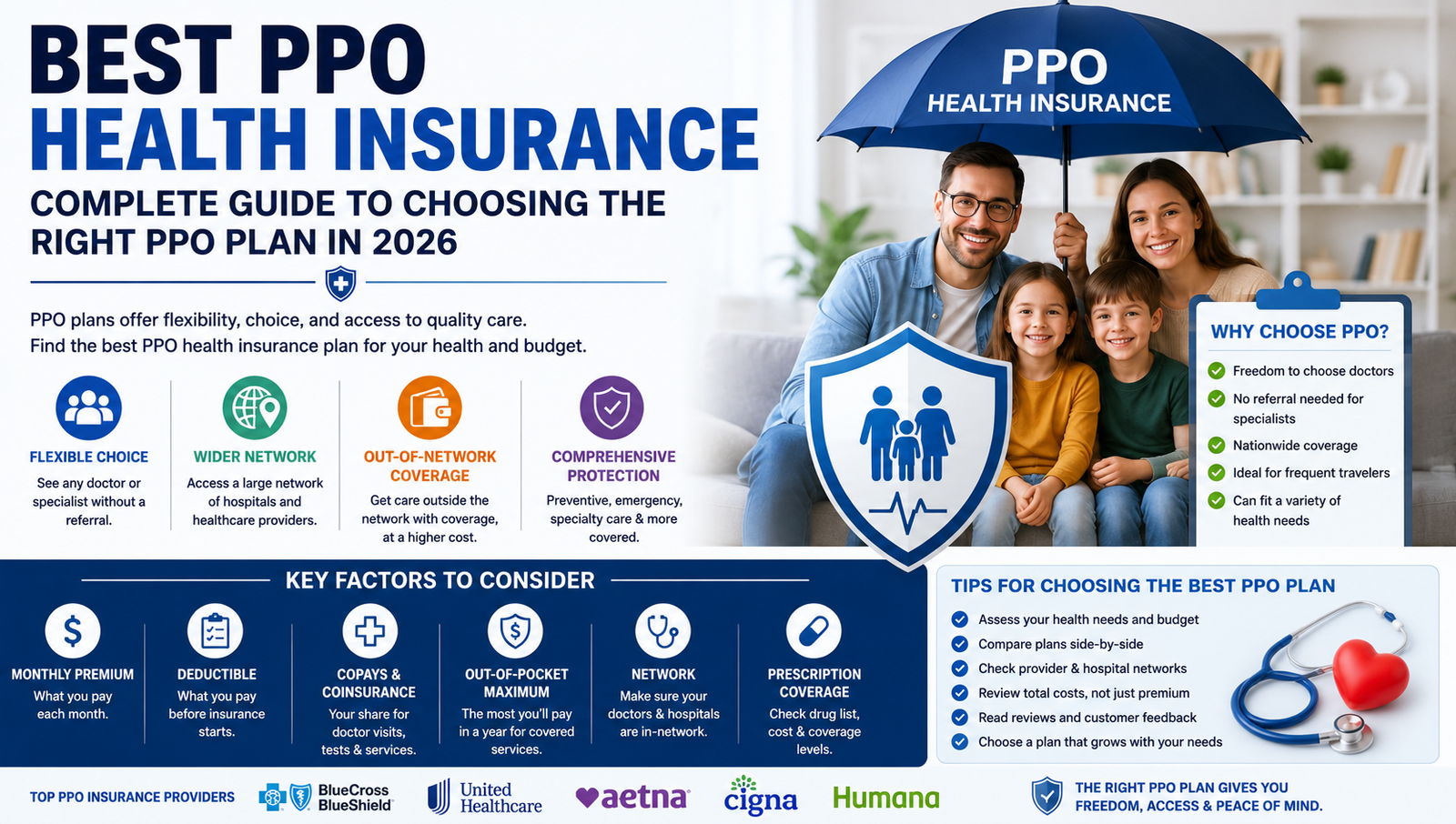
Choosing the right health insurance plan can be challenging, especially with the many options available in the United States. Among the most popular choices are Preferred Provider Organization (PPO) plans, which are known for offering greater flexibility when selecting doctors, specialists, and healthcare facilities.
For people who value provider choice and want the ability to seek care outside their insurance network, a PPO can be an attractive option. However, PPO plans can also have higher premiums and out-of-pocket costs than some other types of health plans.
This guide explains what PPO health insurance is, how it works, what to look for in 2026, and how to choose a plan that fits your healthcare needs and budget.
What Is PPO Health Insurance?
A Preferred Provider Organization, commonly called a PPO, is a type of health insurance plan that gives members access to a network of preferred doctors, hospitals, and other healthcare providers.
You can generally receive care from providers inside or outside the network. However, using in-network providers usually results in lower out-of-pocket costs.
One of the biggest advantages of a PPO is that you typically do not need a referral from a primary care doctor to see a specialist. This can make it easier to access dermatologists, cardiologists, orthopedic specialists, and other healthcare professionals.
How Does a PPO Plan Work?
When you enroll in a PPO plan, you pay a monthly premium to maintain coverage. When you receive healthcare services, you may also have to pay a deductible, copayment, or coinsurance depending on the service and plan design.
PPO plans generally have two levels of coverage:
In-network care: You receive services from providers who have agreed to negotiated rates with the insurance company. Your share of the cost is usually lower.
Out-of-network care: You can generally visit providers outside the network, but you may pay more. Some out-of-network services may also have separate deductibles, higher coinsurance, or balance-billing risks.
Understanding these differences is essential before selecting a PPO plan.
Key Benefits of PPO Health Insurance
1. Greater Provider Flexibility
One of the main reasons people choose PPO insurance is flexibility. You can generally choose from a broad network of healthcare providers and may have coverage for eligible out-of-network care.
This can be especially useful if you frequently travel, live in multiple locations, or already have doctors you want to continue seeing.
2. No Specialist Referral in Most PPO Plans
Many PPO plans allow members to see specialists without obtaining a referral from a primary care physician.
This can save time and make it easier to seek specialized medical care when needed.
3. Out-of-Network Coverage
Unlike many more restrictive plans, PPO insurance generally provides some level of coverage for eligible out-of-network services.
However, out-of-network care can be significantly more expensive, so members should check their plan’s specific rules before receiving care.
4. Nationwide Access
Some PPO plans have broad networks that can be particularly useful for people who travel frequently.
If you spend time in different states, check whether the plan’s network provides convenient access to doctors and hospitals in the areas where you live or travel.
Best PPO Health Insurance Providers to Consider
There is no single PPO insurer that is best for everyone. Availability, pricing, provider networks, and plan options vary by state and county.
Major U.S. health insurance companies that may offer PPO options in certain markets include Blue Cross Blue Shield companies, UnitedHealthcare, Aetna, Cigna Healthcare, and Humana. However, the availability of specific PPO plans depends on where you live and whether you are purchasing individual, employer-sponsored, Medicare, or other coverage.
When comparing insurers, focus on the actual plan rather than choosing a company solely because of its name.
A lower premium does not necessarily mean a better plan if the deductible is very high or your preferred doctors are out of network.
Important Costs to Compare
The monthly premium is only one part of the total cost.
Monthly Premium
This is the amount you pay each month to maintain your insurance coverage. A PPO may have a higher premium than some other plan types because of its greater provider flexibility.
Deductible
The deductible is the amount you generally pay for covered services before the insurance plan begins paying according to its cost-sharing rules.
A plan with a low premium may have a higher deductible, while a more expensive plan may provide lower cost-sharing.
Copayments
A copayment is a fixed amount you pay for certain covered healthcare services, such as a doctor’s visit or prescription.
Coinsurance
Coinsurance is the percentage of the allowed cost you pay after meeting applicable deductibles.
Out-of-Pocket Maximum
This is one of the most important numbers to check. It represents the maximum amount you may have to pay for covered services during a plan year, subject to the plan’s rules and exclusions.
A lower out-of-pocket maximum can provide greater financial protection if you expect significant healthcare expenses.
How to Choose the Best PPO Plan in 2026
Start by considering your healthcare needs.
If you rarely visit doctors and mainly want protection against unexpected medical expenses, you might prioritize a lower premium.
If you regularly see specialists, take prescription medications, or expect medical procedures, a plan with a higher premium but lower cost-sharing could potentially provide better overall value.
Next, check the provider network. Make sure your preferred primary care doctor, specialists, hospitals, and healthcare facilities participate in the plan.
Prescription drug coverage is also important. Review the plan’s drug formulary and check whether your medications are covered and what tier they fall into.
Finally, compare the deductible, copayments, coinsurance, and out-of-pocket maximum rather than focusing only on the monthly premium.
PPO vs. HMO: Which Is Better?
PPO and HMO plans work differently.
PPO plans generally provide more flexibility, including access to out-of-network care and specialist visits without referrals in many plans.
HMO plans usually emphasize using a defined network and coordinating care through a primary care provider. They can sometimes have lower premiums or out-of-pocket costs.
A PPO may be a better choice for people who prioritize flexibility and provider choice. An HMO may appeal to people who prefer coordinated care and lower costs.
Neither option is automatically better. Your healthcare needs and budget should determine the right choice.
Questions to Ask Before Buying a PPO Plan
Before enrolling, ask:
- Are my preferred doctors in network?
- Are my preferred hospitals covered?
- How much is the monthly premium?
- What is the annual deductible?
- What is the out-of-pocket maximum?
- How much will specialist visits cost?
- How does out-of-network coverage work?
- Are my prescriptions covered?
- Does the plan cover healthcare when I travel?
- Are there separate deductibles for certain services?
- What services require prior authorization?
Reading the plan’s official Summary of Benefits and Coverage can help you compare policies more accurately.
Final Thoughts
The best PPO health insurance plan in 2026 is not necessarily the cheapest plan or the plan offered by the biggest insurer. The right choice depends on your healthcare needs, preferred doctors, medications, location, expected medical expenses, and budget.
PPO insurance can be especially appealing if you value provider flexibility, specialist access, and out-of-network coverage. However, these advantages can come with higher premiums and cost-sharing.
Before enrolling, compare the complete costs and benefits of several plans. Check provider networks, prescription coverage, deductibles, coinsurance, copayments, and out-of-pocket maximums.
Most importantly, verify the current plan details for your location before making a decision, because PPO availability and benefits can vary significantly by state and insurance market.