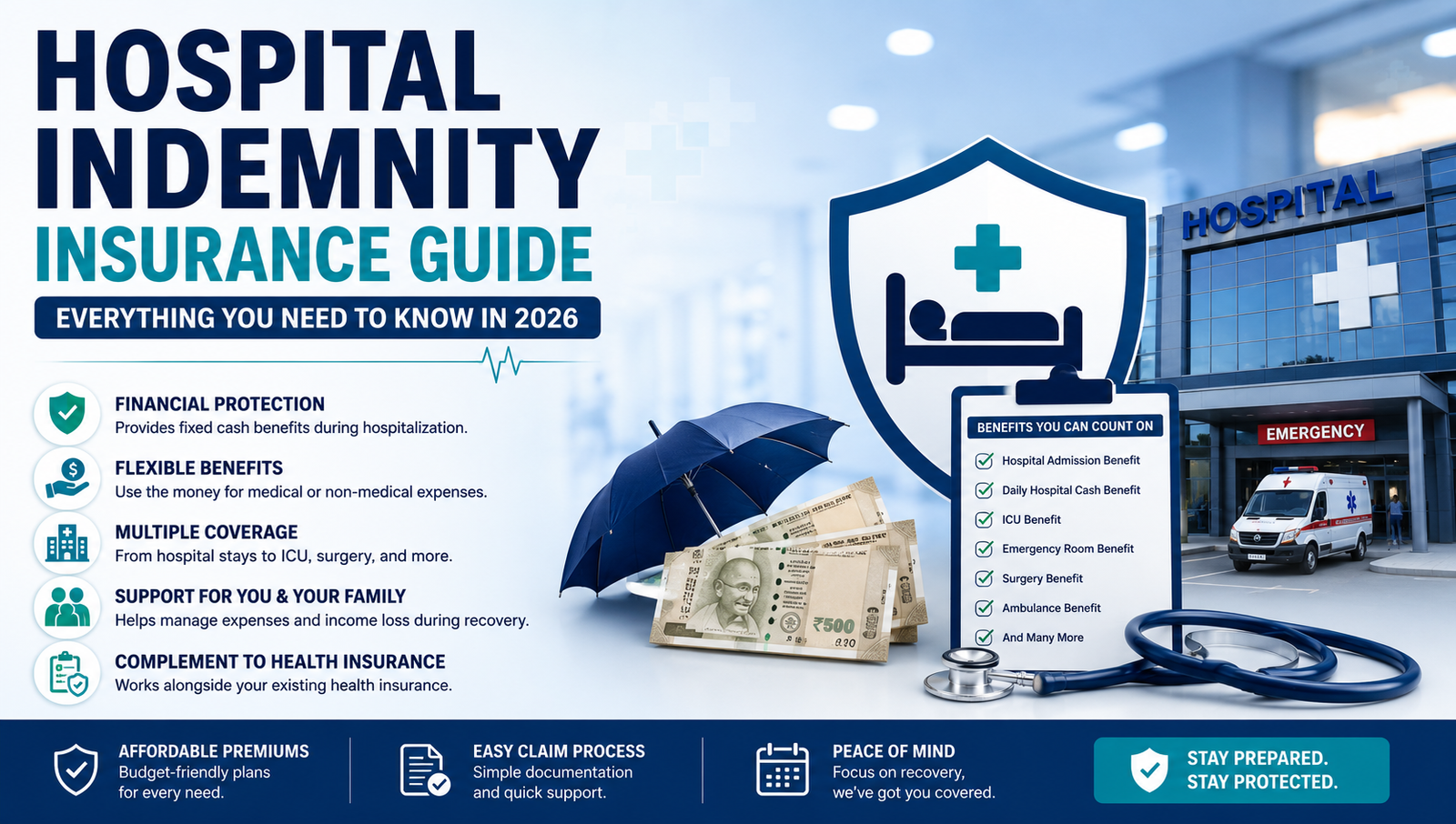
Hospitalization can be expensive, even when you already have health insurance. From room charges and diagnostic tests to medicines, transportation, and other out-of-pocket expenses, a hospital stay can put significant pressure on your finances. This is where Hospital Indemnity Insurance can provide an additional layer of financial protection.
In 2026, understanding how hospital indemnity coverage works can help individuals and families make better decisions about their overall insurance strategy. This guide explains what hospital indemnity insurance is, how it works, what it covers, its benefits, limitations, and who should consider buying it.
What Is Hospital Indemnity Insurance?
Hospital indemnity insurance is a type of supplemental insurance that provides a fixed cash benefit when you are hospitalized for a covered condition.
Unlike traditional health insurance, which generally pays eligible medical bills directly to hospitals or healthcare providers, hospital indemnity insurance typically pays the policyholder a predetermined amount. You can generally use this money for medical or non-medical expenses, depending on the policy terms.
For example, a policy may provide a fixed daily benefit for each day you spend in a hospital, along with additional benefits for covered procedures, intensive care, or emergency treatment.
The exact benefits, waiting periods, exclusions, and eligibility requirements vary between insurance providers and policies.
How Does Hospital Indemnity Insurance Work?
Hospital indemnity insurance is relatively straightforward.
First, you purchase a policy and pay the required premium. If you are later admitted to a hospital for a covered event, you can submit a claim according to the insurer’s requirements.
If the claim is approved, the insurer pays the benefit specified in your policy.
For example, imagine your policy provides a hospital admission benefit of $500 and a daily hospitalization benefit of $200. If you are admitted for four covered days, you could potentially receive $1,300 in benefits, depending on the policy terms.
The payment is generally not designed to reimburse every hospital bill. Instead, it provides additional financial support that can help you manage expenses associated with hospitalization.
What Does Hospital Indemnity Insurance Cover?
Coverage depends heavily on the policy you select. Common benefits may include:
- Hospital admission benefits
- Daily hospital confinement benefits
- Intensive care unit benefits
- Emergency room benefits
- Ambulance benefits
- Surgery-related benefits
- Certain outpatient procedures
- Diagnostic services
- Rehabilitation or recovery benefits
Some policies may also offer additional benefits for specific medical events or treatments.
It is important to read the policy documents carefully because a benefit listed in an insurance advertisement may have specific conditions, limits, or exclusions.
Why Consider Hospital Indemnity Insurance in 2026?
Healthcare costs continue to be a concern for many households. Even people with comprehensive health insurance can face deductibles, copayments, coinsurance, transportation expenses, lost income, and other costs during a serious illness.
Hospital indemnity insurance can help fill some of these financial gaps.
One of its major advantages is flexibility. Because the benefit is generally paid directly to the insured person, the money can potentially be used for eligible purposes such as medical bills, household expenses, transportation, childcare, or other financial obligations.
This can be particularly valuable when hospitalization prevents someone from working temporarily.
Hospital Indemnity Insurance vs. Traditional Health Insurance
The two types of coverage serve different purposes.
Traditional health insurance primarily helps pay for covered healthcare services. Depending on the plan, the insurer may pay healthcare providers directly after applying deductibles, copayments, and other cost-sharing requirements.
Hospital indemnity insurance, on the other hand, provides a predetermined cash benefit when a covered hospitalization or medical event occurs.
In simple terms, health insurance helps cover healthcare costs, while hospital indemnity insurance can provide additional cash to help manage the financial impact of hospitalization.
The two policies can therefore complement each other rather than replace one another.
Key Benefits of Hospital Indemnity Insurance
1. Additional Financial Protection
A hospital stay can create expenses beyond the medical bill. Supplemental cash benefits can provide extra financial support during recovery.
2. Flexible Use of Benefits
Depending on the policy, the benefit may be used for a variety of expenses rather than being restricted to a specific medical bill.
3. Helps With Unexpected Costs
Unexpected hospitalization can disrupt a household budget. A fixed benefit may help reduce the financial shock.
4. Can Complement Health Insurance
Hospital indemnity coverage is generally designed to supplement, rather than replace, primary health insurance.
5. Potential Support During Recovery
If hospitalization results in missed work or additional household expenses, the benefit may help provide temporary financial relief.
Important Limitations to Understand
Hospital indemnity insurance is not a substitute for comprehensive health insurance.
Policies can contain exclusions, benefit limits, waiting periods, eligibility requirements, and restrictions on pre-existing conditions. Some policies may also have specific definitions of hospitalization or covered services.
Another important consideration is that benefits are usually fixed. If your actual medical expenses are much higher than the benefit amount, the policy may cover only a portion of the overall financial impact.
Before purchasing coverage, compare the premium with the potential benefits and carefully review the policy’s exclusions and limitations.
Who Should Consider Hospital Indemnity Insurance?
This type of coverage may be worth considering for people who:
- Have a health insurance plan with significant out-of-pocket costs
- Want additional protection against hospitalization expenses
- Have limited emergency savings
- Are concerned about income disruption during a hospital stay
- Want supplemental coverage alongside their existing health insurance
However, the value of a policy depends on your personal circumstances, existing insurance, budget, and financial priorities.
How to Choose the Right Policy
When comparing hospital indemnity insurance policies in 2026, look beyond the premium.
Consider the hospital admission benefit, daily hospitalization amount, intensive care benefit, maximum benefit limits, waiting periods, exclusions, renewal terms, and claim requirements.
Also check whether the policy covers the types of hospitalization and treatments you are most concerned about.
Most importantly, read the complete policy wording before purchasing. Insurance advertisements provide a summary, while the policy documents contain the actual terms and conditions.
Final Thoughts
Hospital indemnity insurance can provide an additional financial safety net when hospitalization creates unexpected expenses. It works differently from traditional health insurance by providing predetermined cash benefits for covered hospital stays and other qualifying events.
In 2026, consumers should carefully evaluate their existing health insurance, emergency savings, expected healthcare needs, and overall budget before buying supplemental coverage.
The right policy can provide useful financial support, but it should generally be viewed as a supplement to comprehensive health insurance not a replacement for it. Comparing benefits, exclusions, costs, and policy conditions is essential before making a decision.